Dining Hall Planning for South Indian Weddings: Seating, Service, and Flow at Sri Hariharan Marriage Hall
Practical guidance on arranging seating, batching guests, and organising service flow for traditional South Indian meals in a dining hall that seats about 100 per session, with tips specific to Sri Hariharan Marriage Hall in Nanganallur.
Why focused dining planning matters
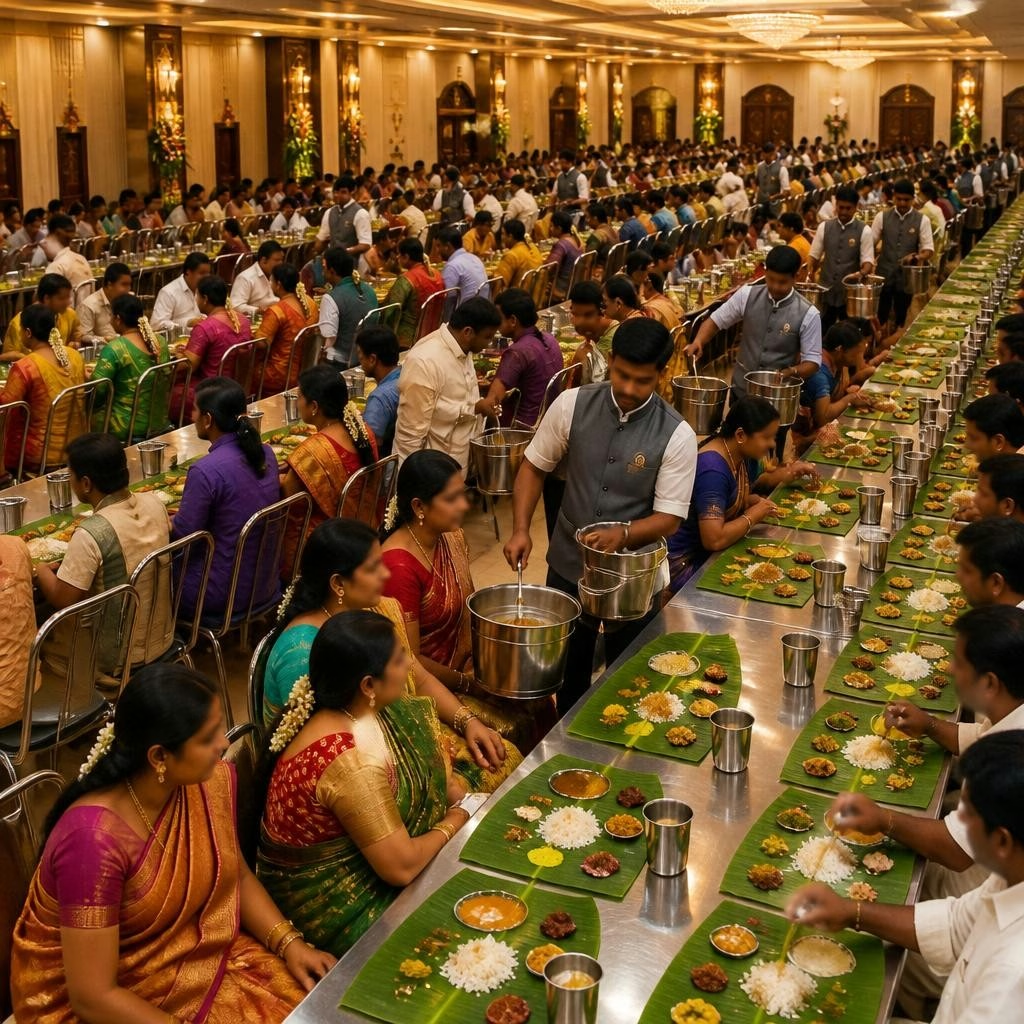
A South Indian wedding meal is central to the guest experience, but it can also be a point of congestion if seating and service are not organised. Careful planning reduces waiting, preserves the traditional style of service (banana-leaf meals or plated thali service), and helps the venue maintain cleanliness and comfort. At venues like Sri Hariharan Marriage Hall—where reviewers note a dedicated dining hall that comfortably accommodates about 100 guests per session—planning becomes essential when the total guest list exceeds that single-session capacity.
Understand the dining space and capacity
Begin with an accurate count of the dining hall’s usable seating. Reviews of this venue indicate the dining area handles roughly 100–110 persons per session and that the overall function hall accommodates around 200–225 guests. Account for aisles, servers’ circulation space and any podium or buffet set-up when calculating usable seats. Also note facility details reported by guests—working air conditioning, a functional kitchen with LPG and utensils, lift access and comfortable lighting—which all influence how you arrange seating and serve efficiently.
Seating layouts that respect tradition and flow
For traditional South Indian meals, consider linear seating (rows of banana leaves) or closely spaced tables depending on formality. Linear rows work well when servers move along both sides; table layouts suit plated or buffet service. Reserve a front or easily accessible area for elders and guests with mobility needs—reviews highlight lift access and the availability of wheelchairs at this venue, so place these seats near the lift and restrooms. Leave clear aisles of at least one metre for servers and for guests to move without crowding.
Batching guests: how to calculate and schedule
When the dining hall seats about 100 at a time, determine the number of batches by dividing total diners by the hall’s session capacity and rounding up. For example, a 300-person meal would require three batches. Stagger arrival or serving times by batch so guests are informed when their session will be served. Use invitations, signage, or an MC announcement to guide guests to the dining area in ordered groups (by relation, arrival time, or table zones) to avoid everyone arriving at once.
Designing an efficient service flow
A smooth service flow reduces wait times and keeps food hot and fresh. Assign clearly defined roles for plating, serving, and clearing. If the kitchen supports on-site plating (reviews confirm a well-equipped kitchen), prepare staple items in advance and stagger hot-item finishing to match each batch. Allow a planned service window for each batch—communicate how long the meal service will take—and coordinate clearing between batches so the next group can be seated promptly. Simple signals (bells or announcements) and a visible host/volunteer at the dining entry help maintain the schedule.
Staffing, kitchen logistics and equipment
Confirm the kitchen’s scope and available equipment early in planning; reviewers mention a maintained kitchen with LPG and necessary utensils, which supports large-batch preparation. Plan for dedicated staff to plate, serve, and clear so servers are not diverted for other tasks. Arrange hot-holding or covered carriers for temperature control if batches are spaced. Ensure waste collection points and rinse stations are ready to keep the dining area tidy between sessions—this helps the venue maintain the cleanliness that past guests have praised.
Accessibility, parking and guest comfort
Guest comfort extends beyond the meal itself. Reviews of Sri Hariharan Marriage Hall frequently note lift access, AC comfort and helpful staff—use those features to prioritise seating for elderly or differently-abled guests. Parking is generally available but can be limited for cars in peak times, according to feedback, so plan for staggered arrivals, coordinate on-site valet where possible, and provide clear directions to two-wheeler parking. Signage to restrooms, lift access and dining entrances reduces confusion and keeps flow steady.
Day‑of checklist for a smooth dining experience
Before the event, confirm: final guest count and calculated number of batches; seating diagram showing aisles and priority seating; exact service timeline per batch; roles and headcount for servers, plate‑prep and clearing team; kitchen readiness (fuel, utensils, hot-holding); parking/valet plan; and signage/announcements for guiding guests. Assign one point person to handle timing adjustments with the venue manager—reviewers repeatedly praise attentive management, and a single coordinator helps preserve that smooth communication on the day. A clear checklist and communication plan will keep guests comfortable and the meal service timely and dignified.
Article by
Sri Hariharan Marriage Hall Nanganallur
Sri Hariharan Marriage Hall is an air-conditioned wedding hall on MGR Road in Nanganallur, Chennai, hosting weddings, receptions, engagements and family functions since 2011. The hall has lift access, covered car parking and valet parking, and is easy to reach from Nanganallur, Madipakkam, Alandur and the airport. Our team helps families plan every detail so the day runs smoothly. Contact us to check available dates or visit the hall.